
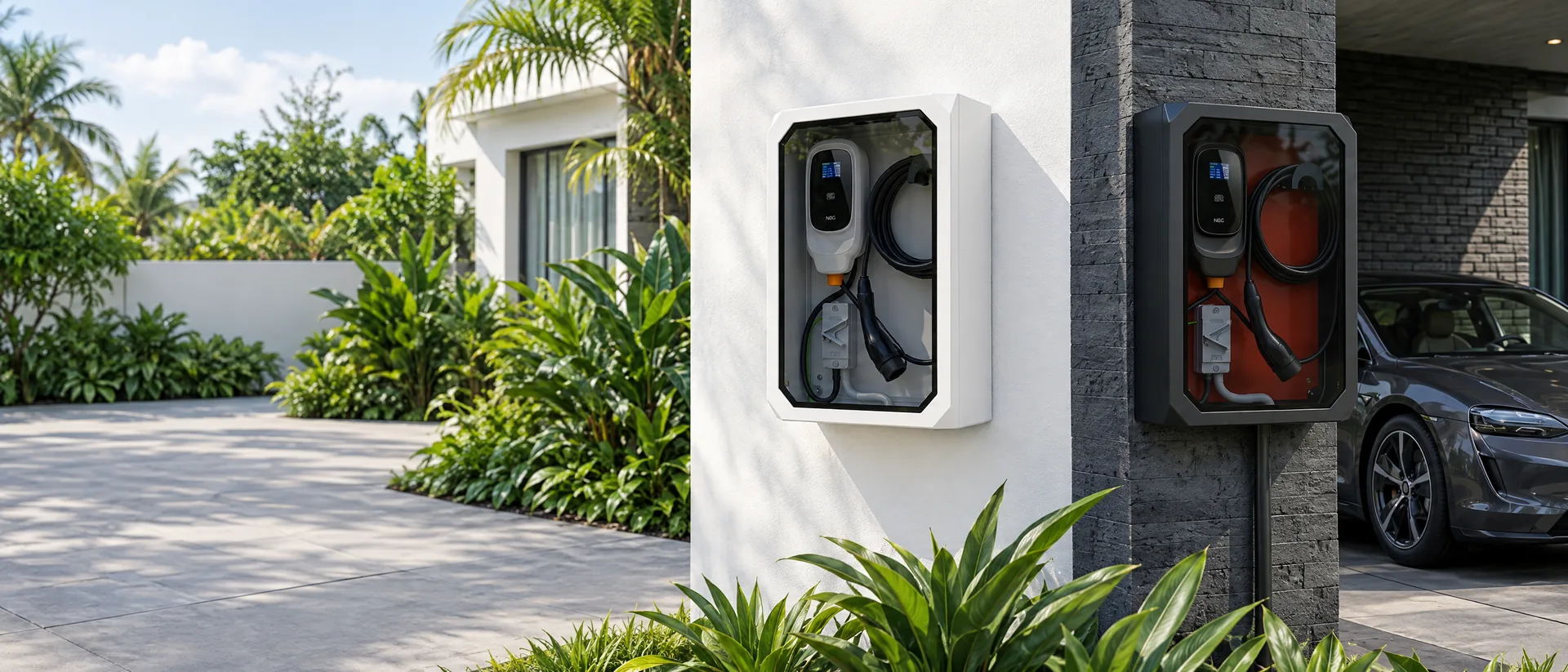
Not every charger gets a sheltered wall
Car parks, yards, depots and driveways rarely have a dry, protected surface at the right height. So we build the charger a home: a lockable enclosure, a standalone post, or both. It has to survive the weather, and everything else that happens on a working site.
- Lockable enclosure around the unit
- Standalone post where there is no wall
- Charge-port rain shield included
- Designed around your site at survey
Singapore is a hard place to leave a charger unprotected
Chargers are built to be outdoors. That is not the same as being built for a tropical downpour, an open yard and a reversing lorry.
Driven rain
A unit rated for outdoor use still has a cable entry, a socket and a connector holster. An enclosure keeps horizontal rain off the parts that were never meant to take it head-on.
Heat and sun
Direct afternoon sun raises the internal temperature of a charger and ages a plastic fascia. Shade is the cheapest way to extend the life of the unit you just paid for.
Knocks and reversing
On a working site the risk is not weather, it is a vehicle. A post is set where it can be seen, and an enclosure takes the scrape instead of the charger.
Tampering and theft
A lockable door means the connector and the unit are not simply available to anyone walking past a shared or public-facing bay.
Wall, post, or post with an enclosure
The right answer comes from the site, not the catalogue. We work it out at the survey and show you which one your parking actually needs.
Wall-mounted
The default where there is a suitable wall
- What it needs
- A sound wall within reach of the parking space, ideally under cover
- Protection
- The unit's own weatherproofing, plus a sealed cable entry
- Best for
- Landed homes, sheltered car parks, most residential installs
- Worth knowing
- Cheapest and quickest. If the wall is exposed to driven rain, we will suggest adding an enclosure.
Standalone post
When there is no wall to use
- What it needs
- A base fixed into the ground, and a cable route to it
- Protection
- Puts the unit at working height and where drivers can see it
- Best for
- Open yards, forecourts, bays away from any structure
- Worth knowing
- The groundwork is the job. We confirm the route and the fixing at survey rather than on the day.
Post with enclosure
Exposed and shared sites
- What it needs
- The same base and cable route, plus space for the door to swing
- Protection
- Weather, sun, knocks and tampering — the charger sits fully inside
- Best for
- Depots, industrial yards, commercial bays, anywhere public-facing
- Worth knowing
- The most protection, and the usual answer where a unit is left unattended outdoors.
Enclosure and post options depend on the charger you choose and the site. We confirm what fits during the free survey — nothing is ordered before that.
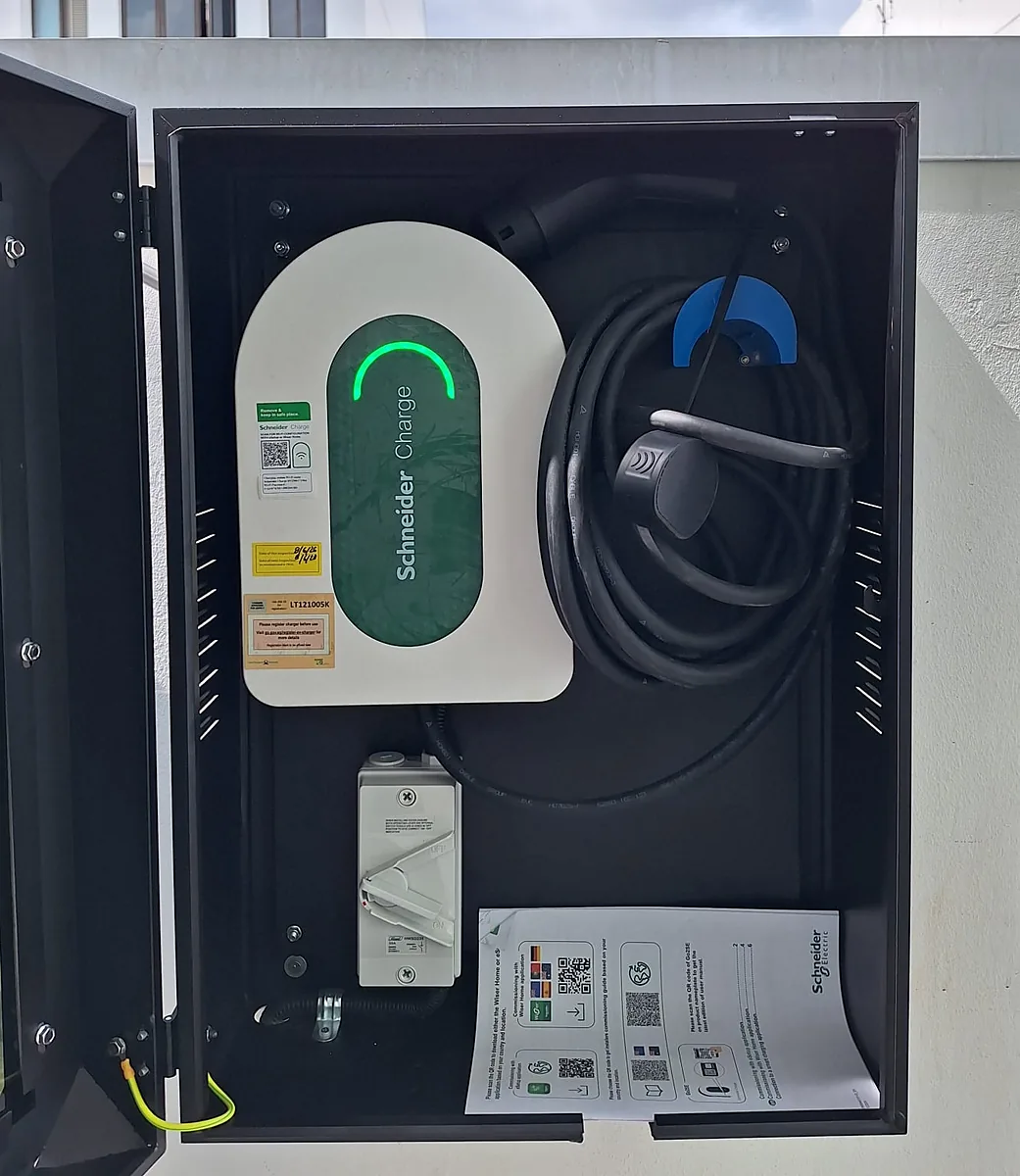
A casing that protects your charger, and opens the way you want it to
The casing is there to protect your charger — from driven rain, from the afternoon sun, and from the knocks a working site delivers. How it opens is the other half of the job: a charger you cannot reach is not protected, it is trapped.
So the door has to clear the connector, the cable has to coil without kinking, and the isolator has to stay within reach without unbolting anything. We settle all of that at the survey, along with where the unit goes, rather than later from a photo. That way a service visit or a firmware update never turns into a dismantling job.
- Door clears the connector and holster
- Cable coils without a tight bend
- Isolator stays reachable
- Ventilation kept clear
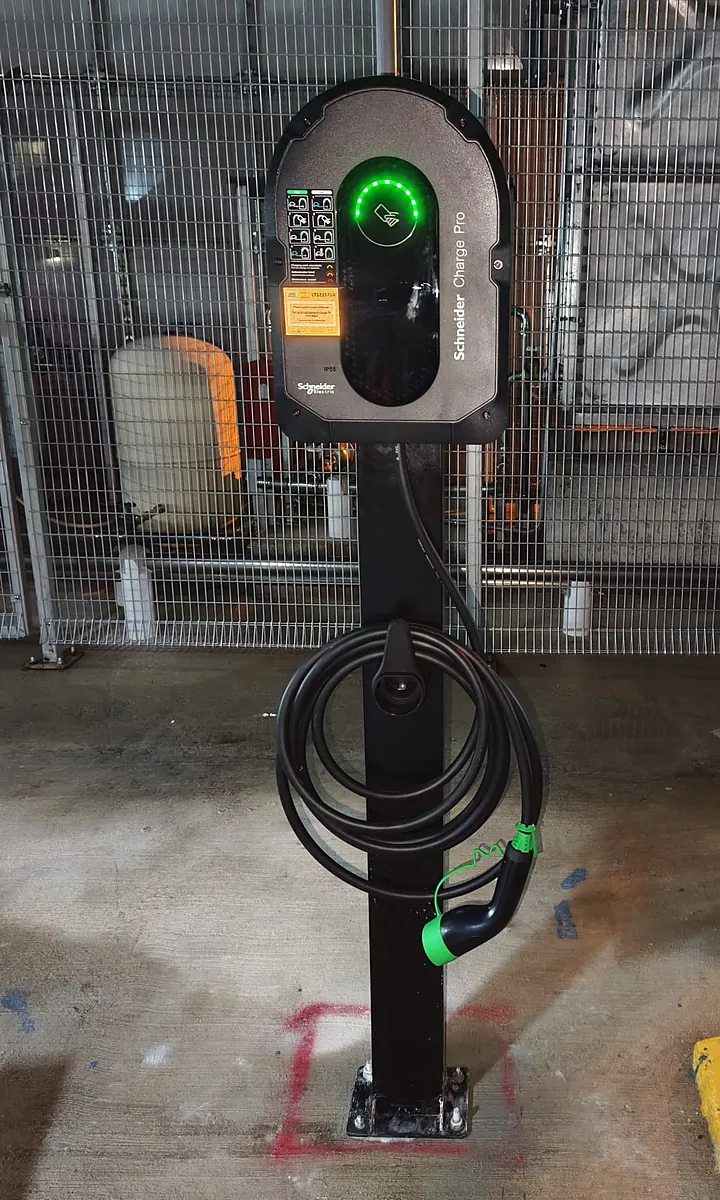
A post puts the charger where the vehicle actually stops
On a yard or a forecourt, the nearest wall is often nowhere near where the vehicle parks. Running a longer cable to reach a bad spot is the wrong fix. It leaves the connector on the ground and the driver in the rain.
A post goes where the parking is. It sets the unit at working height, keeps the cable off the deck, and gives the charger a visible footprint that drivers steer around instead of into.
- Sited where the vehicle stops
- Unit at comfortable working height
- Connector kept off the ground
- Visible footprint on a busy yard
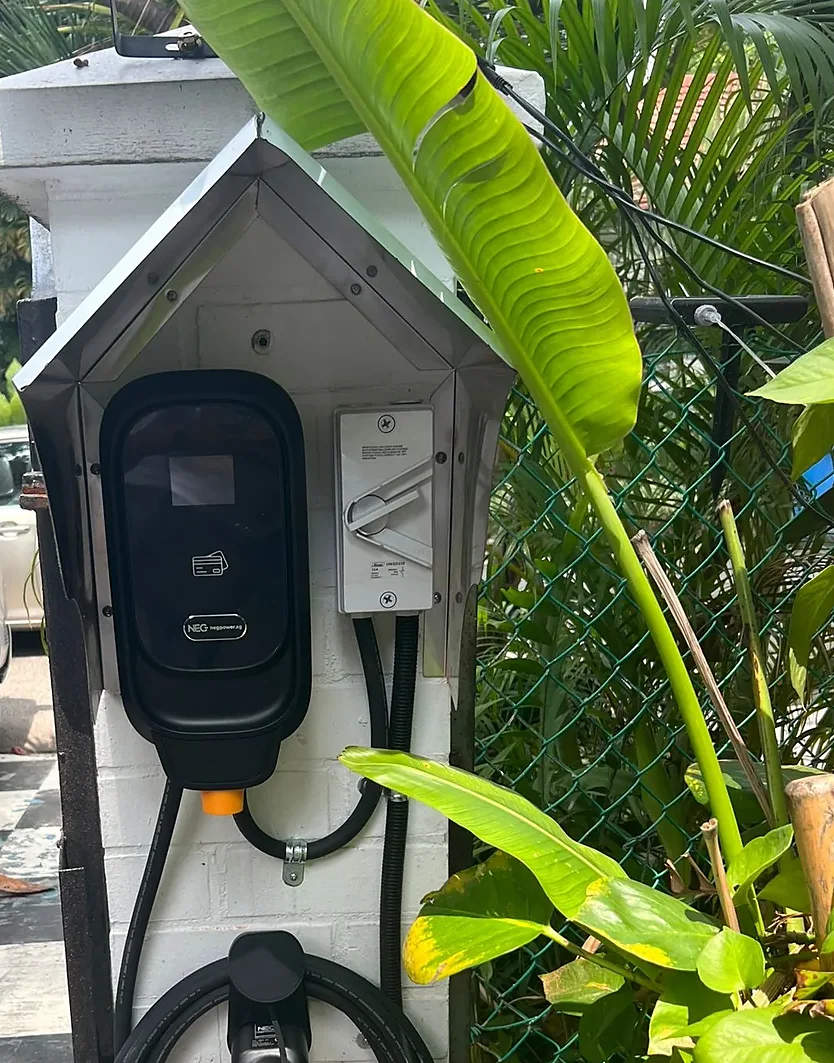
A stainless steel rain canopy, for a charger with nothing above it
A wall charger out in the open takes the weather head on. It is built for that. But a gate pillar in full sun and driving rain is harder on it than a sheltered porch, and the screen and the seals show it first.
The canopy is a pitched stainless hood fixed over the charger and its isolator. It throws the rain clear of the face instead of letting it run down, and it keeps the direct afternoon sun off the display so it stays readable. Stainless because it lives outdoors and the fixings have to last as long as the charger.
- Sheds rain clear of the charger face
- Shades the display from direct sun
- Covers the isolator as well as the unit
- Stainless steel, for a wall or a pillar
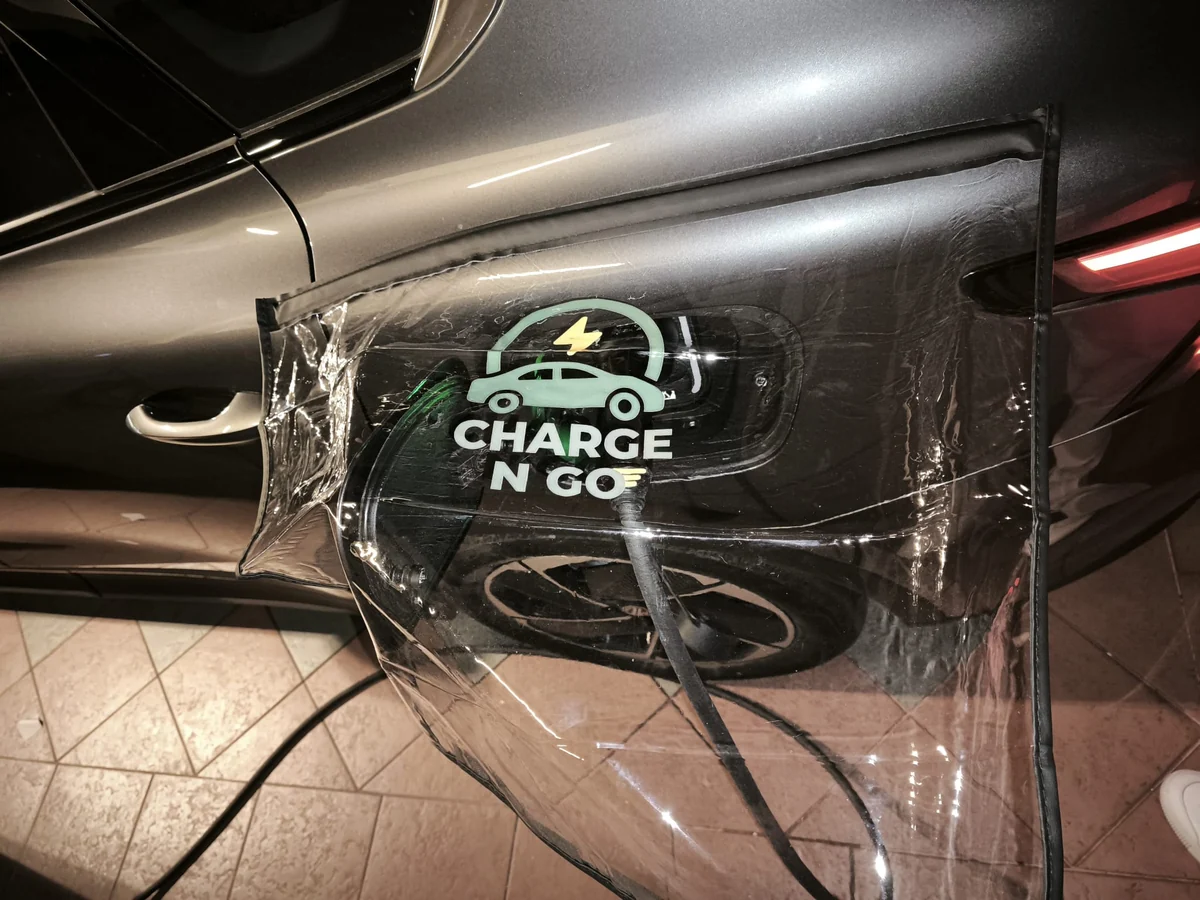
The charge port is the part the rain actually reaches
You can shelter the charger perfectly and still have the vulnerable moment happen at the car: a connector seated in an open port, in the rain, for hours.
Our rain shield goes over that. It comes free with every installation we do. It is the difference between a dry connection and a puddle where the cable meets the car. Your charging port stays dry even in a thunderstorm.
- Covers the port while charging
- Works with any Type 2 connector
- Packs away when not in use
- Free with every Charge N Go installation
Four things we settle before anything is ordered
- 1
Look at the parking
Where the vehicle actually stops, which way it reverses in, and whether there is a usable wall within a sensible cable run.
- 2
Read the exposure
Which direction the rain drives from, how much afternoon sun the spot takes, and whether anything already shelters it.
- 3
Decide wall, post or enclosure
We recommend the least you actually need. A sheltered landed driveway rarely needs a cabinet; an open depot bay almost always does.
- 4
Quote it as one job
Charger, housing, groundwork, cable run and LTA registration on a single quote after the survey — not a housing invoice that appears later.
Charger housing questions
Do I need an enclosure for my EV charger?
Most landed homes do not. If the charger sits under a porch or a car porch roof and is not taking driven rain, the unit's own weatherproofing is what it was designed for. An enclosure earns its place when the charger is fully exposed, on a shared or public-facing bay, or on a working site where vehicles move around it. We tell you which situation you are in at the survey rather than selling a cabinet by default.
Can you install a charger where there is no wall?
Yes — that is what a standalone post is for. The unit mounts on a steel post fixed into the ground at the parking space, with the supply run to it underground or in conduit. The groundwork and the cable route are the real work, so we confirm both at the survey before quoting.
Does an enclosure make servicing harder?
It should not, and that is a design decision rather than luck. The door has to clear the connector and holster, the cable needs to coil without a tight bend, and the isolator has to stay reachable. We set the enclosure out with that in mind so a service call or a firmware update does not mean unbolting the housing.
What is the rain shield and do I have to pay for it?
It is a cover that goes over the car's charge port while charging, so a connector seated in an open port is not sitting in the rain for hours. It works with any Type 2 connector and packs away when you are not using it. It comes with our installations.
Will housing affect my LTA registration?
No. Registration is about the charger itself, and every AC charger we install is registered with LTA as part of the job regardless of how it is mounted. The housing is a protection and mounting decision, not a compliance one.
Can you add an enclosure to a charger I already have?
Often, yes — send us a photo of the unit, its isolator and the surrounding wall or post and we will tell you what fits. If the existing installation has other problems, we will flag those too, because a cabinet around a badly installed charger just hides the issue.