Getting an EV charger in your condo: the MCST route
How a Singapore condo adds EV chargers: the MCST vote, who owns and pays, planning power and lots, the ECCG grant, and inspections once they are in.
The short answer
In a condo the car park is common property, so chargers go in through the management corporation (MCST). Since 8 December 2023 an ordinary resolution (a simple majority at a general meeting) is enough for qualifying EV charger proposals, as long as the lease with the charging operator does not exceed 10 years and no MCST funds are drawn down. The MCST then plans the chargers, decides who owns and pays, installs and registers them, and keeps them inspected.
- Residents do not install their own chargers in common car parks; the MCST decides, usually by resolution at an annual or extraordinary general meeting.
- LTA says an ordinary resolution suffices for qualifying EV charger proposals, which makes the vote easier than it used to be.
- There are three ownership models: capex-free, hybrid and capex-intensive, and they decide who pays, who sets prices and who maintains.
- A licensed electrical worker should check spare power at the switch room before the MCST commits to a number of chargers.
- The ECCG may co-fund shared chargers at eligible non-landed private residences until 31 December 2026 or until 3,500 chargers are supported, whichever is earlier.
- Owners of non-landed chargers must have them inspected every 6 months by a specialist and every 12 months by a LEW.
On this page (7 sections)
Can you install an EV charger in a condo?
Yes, but not on your own. A condo's car park is a common area, so installing chargers there is a decision for the management corporation strata title (MCST), not an individual owner. For an existing condo not undergoing specified building or electrical works, this is normally an MCST-led decision. LTA separately requires minimum charging provisions for developments undergoing specified works, including erection or re-erection, a gross-floor-area increase of at least 50%, or electrical works resulting in an approved load above 280kVA, subject to the published exemptions. Residents should ask the council which route applies to their development.
The rules got easier on 8 December 2023. LTA says an amendment to the Building Maintenance and Strata Management Act lowered the resolution threshold for EV charger installation proposals to an ordinary resolution requiring a simple majority of votes at the meeting. It applies to two kinds of proposal: enacting by-laws on using parking lots for EV charging, such as designating lots for EVs only, and installing or uninstalling EV chargers, as long as the lease between the MCST and the charging operator does not exceed 10 years and the proposal does not draw down on MCST funds.
This guide is about condos and other non-landed private residences. HDB car parks work differently, with chargers run by operators; see our guide on HDB, condo and landed charging. Landed homes charge on their own land, which is a simpler case covered in our home installation guide.
The four phases an MCST goes through
LTA's guide splits a condo charger project into four phases. Knowing them helps a resident see where a proposal currently stands and what the council will ask for next.
- 1
Pass the resolution
The MCST puts the proposal to a general meeting, either the AGM or an extraordinary general meeting (EOGM). The ordinary-resolution threshold above applies to qualifying proposals.
- 2
Plan the chargers
This covers charger types and selection, power availability, parking and lot layout, the ownership model, the charging price and the grant. It is the longest phase and the one where most decisions are made.
- 3
Install, certify and register
A Licensed Electrical Worker installs a fixed charger, a charger equipment specialist certifies it, and the charger is registered with LTA before use. LTA also covers 'place making', such as signage that tells residents how to use and report problems with the chargers.
- 4
Operate and maintain
Chargers must be inspected on LTA's schedule, certificates kept, and sensible charging etiquette encouraged among residents.
We do not include the LTA registration fee in our quote, and we do not do the LTA registration for you. Registration is done by the charger's owner, and the fee is paid to LTA.
For a resident the practical lesson is to arrive with answers, not just a request. The sections below cover the main questions the council will need settled in phase two.
Who owns and pays: the three ownership models
LTA describes three ownership models for MCST chargers. The model is one of the biggest choices in the project, because it decides who pays up front, who sets the charging price and who handles maintenance and residents' questions. Capital expenditure, shortened to capex, means the upfront cost of buying and installing the chargers.
| Capex-free | Hybrid | Capex-intensive | |
|---|---|---|---|
| Charger owner | The EV charging operator (EVCO) | The EVCO or the MCST | The MCST |
| Operator | The EVCO | The EVCO | The MCST |
| Hardware and installation cost | The EVCO | The EVCO or the MCST | The MCST |
| Maintenance | The EVCO | The EVCO or the MCST | The MCST |
| Charging fees and revenue | The EVCO sets fees | The EVCO and MCST share revenue | The MCST sets fees and collects revenue |
| Residents' queries | The EVCO | The EVCO and the MCST | The MCST |
The trade-off is control against effort. With capex-free, LTA lists the advantages as no cost for hardware and installation, minimal responsibility for operation and maintenance, and all queries fronted by the operator; the disadvantage is that the operator decides the charging price. Capex-intensive gives the MCST control over prices and flexibility, and it is easier to run innovation projects with the chargers, but at a higher capital cost. Hybrid sits between the two.
LTA advises MCSTs that use an operator to discuss the charging price before engaging them, and suggests asking interested operators for a formula showing how the price is derived, so the MCST can hold them accountable if they propose changes. LTA also says operators that provide charging services or serve condo residents need an EV charging operator licence, so check an operator appears on LTA's published list of licensed operators.
Planning the power, the lots and the number of chargers
Power comes first. LTA says that if a non-landed private residence wants chargers, it should check with the building's facilities manager whether there is enough spare power, and if necessary hire a Licensed Electrical Worker to assess power capacity at the substation and switch room. Where power is limited, the MCST may upgrade the switch room capacity at its own cost or use dynamic load management, which shares available power across chargers.
On numbers, LTA's guidance is to favour more chargers within the available power over fewer high-powered ones, because residents usually charge at home and park overnight. It suggests starting with lower-powered chargers and adding more as electric vehicles and charger use grow, up to the spare capacity. Which rating suits a particular condo is a question for the site survey, not a rule of thumb.
| Point | What LTA says |
|---|---|
| Where chargers go | Near a demarcated lot, not at any free space. |
| Adding lots | More lots can be drawn if the total does not exceed the upper bound of the Range-based Parking Provision Standards, and there is room for standard-size lots without obstructing traffic. |
| Minimum car lot | 2.4m wide and 4.8m long (5.4m for parallel parking). |
| Charger in the lot | If a charger sits in the middle 2,800mm of the lot's length, an extra 300mm of width is needed on each obstructed side. |
| Protection | Wheel stoppers are recommended, and a protective barrier if a charger is on a stand instead of a wall. |
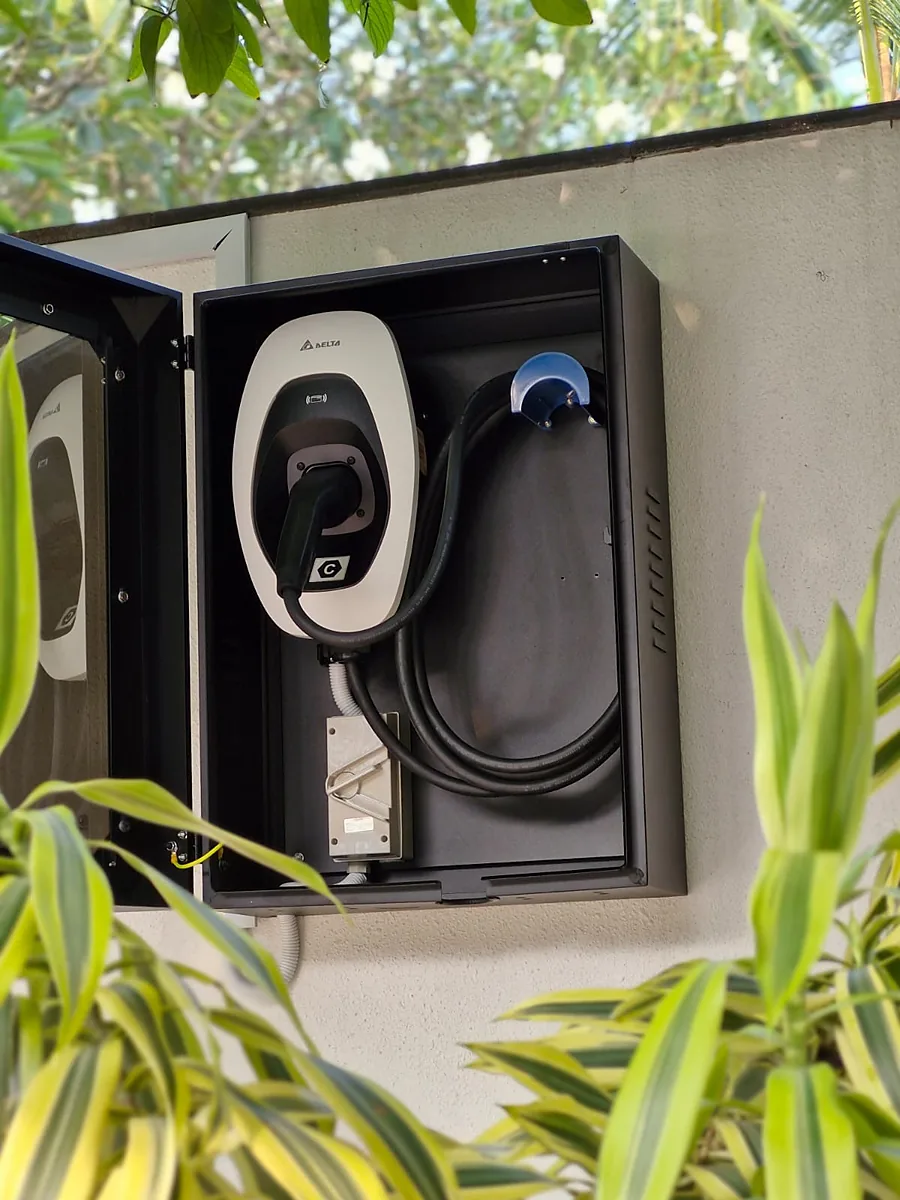
The ECCG grant, and its deadline
LTA's EV Common Charger Grant (ECCG) co-funds shared chargers at non-landed private residences. It is available until 31 December 2026, or until 3,500 chargers have been supported, whichever is earlier. Check LTA's page for the current position before relying on it, because the window is closing.
| Point | What LTA says |
|---|---|
| Co-funding | 50% of each cost component, excluding GST, up to the component cap: the charging system, cabling and installation (capped at S$1,000), and licensed electrical worker fees. |
| Overall cap | The first 2,000 chargers have an overall cap of S$4,000 per charger; the next 1,500 have S$3,000. |
| How many chargers | Up to 1% of residential car park lots, rounded up to the nearest whole number. |
| Which chargers | LTA type-approved smart chargers rated no more than 22kW. They must receive and react to information to adjust charging, monitor and record energy use with timestamps and transmit it, and exchange information using Open Charge Point Protocol version 1.6 or above. |
| Where | Common areas of non-landed private residences, accessible to and shared by residents. |
| Who applies | The charger owner: the MCST, or a licensed charging operator, depending on the ownership model. |
| Timing | Chargers must not be installed before the applicant has received LTA's letter of offer. |
The timing rule is the one that catches people out. A condo that installs first and applies later will not qualify, which is another reason to settle the plan before anything is bought. Our grants guide covers the schemes in more detail.
After the chargers are in: inspections and etiquette
LTA's guide says MCSTs that are the charger owners must engage a LEW and a charger equipment specialist to carry out periodic inspections and rectify defects. For non-restricted access locations such as condos, that means the equipment specialist every 6 months and a LEW every 12 months. After each inspection the specialist issues a certificate to the registered responsible person, who must keep the records and show them to LTA if asked. Our maintenance page covers servicing.
Shared chargers also work better with shared habits. LTA lists measures an MCST can adopt: a digital reservation function in the charging app; an idling fee once a vehicle is fully charged, applied only in reasonable daytime hours so overnight charging is not penalised; physical reservation locks or lighting that shows a charger is reserved; and signage reminding residents to put the cable back, not to overstay in a lot once charged, and not to park in EV lots unless charging.
What a resident can do now
- 1
Find out where the council stands
Ask the management council or managing agent whether chargers have been discussed, and what happened.
- 2
Ask for a power check
A LEW can assess spare capacity at the switch room. The result shapes the proposal.
- 3
Bring the options, not just a request
Set out the three ownership models and who would pay under each. The council will ask.
- 4
Mention the ordinary resolution
LTA's guide describes the simple-majority threshold for qualifying proposals, which can make the vote more achievable.
- 5
Ask for a survey
A condo site survey turns the answers into a layout, a charger count and a phased plan the council can vote on.
Sources
The official pages this guide was checked against.
- Electric Vehicle Guide for Management Corporation Strata Titles (MCSTs) (Land Transport Authority, July 2025)
- Charger grants (ECCG and EHVCG) (Land Transport Authority)
- Electric Vehicle Guide for Drivers (Land Transport Authority)
- Registration of EV chargers (including transfer, relocation and de-registration) (Land Transport Authority)
- Guidelines for the Supply of EV Chargers (Land Transport Authority, as of 15 October 2025)
- Transitioning to EVs (Land Transport Authority)
Written by Charge N Go's installation team. We supply and install EV chargers for homes and businesses across Singapore, and we update this guide when the rules or the sources above change.