Solar EV charger at home: how panels, a battery and your charger work together
How a solar EV charger works at a landed home in Singapore: panels, a home battery and a smart charger, the SP approvals, and why timing matters most.
The short answer
Yes, a landed home can charge an EV from its own solar panels. The charger is a normal type-approved AC wall charger, and the panels supply some of the power it draws. Solar only generates in daylight, so if your car charges in the evening, a home battery (BESS) stores daytime solar for it. A site visit sizes the system.
- A solar EV charger is a normal AC wall charger in a home with solar panels. The panels feed the house, and the charger draws from it.
- Panels generate in daylight. A car that charges in the evening needs a home battery to use that solar.
- Smart chargers can schedule charging, and some can follow your surplus solar.
- Your Licensed Electrical Worker applies to SP for a grid-connected system. Exported solar is credited to your bill or sold through ECIS.
- Sizing is done at a site visit, from your roof, your usage and how you drive.
On this page (7 sections)
What a solar EV charger actually is
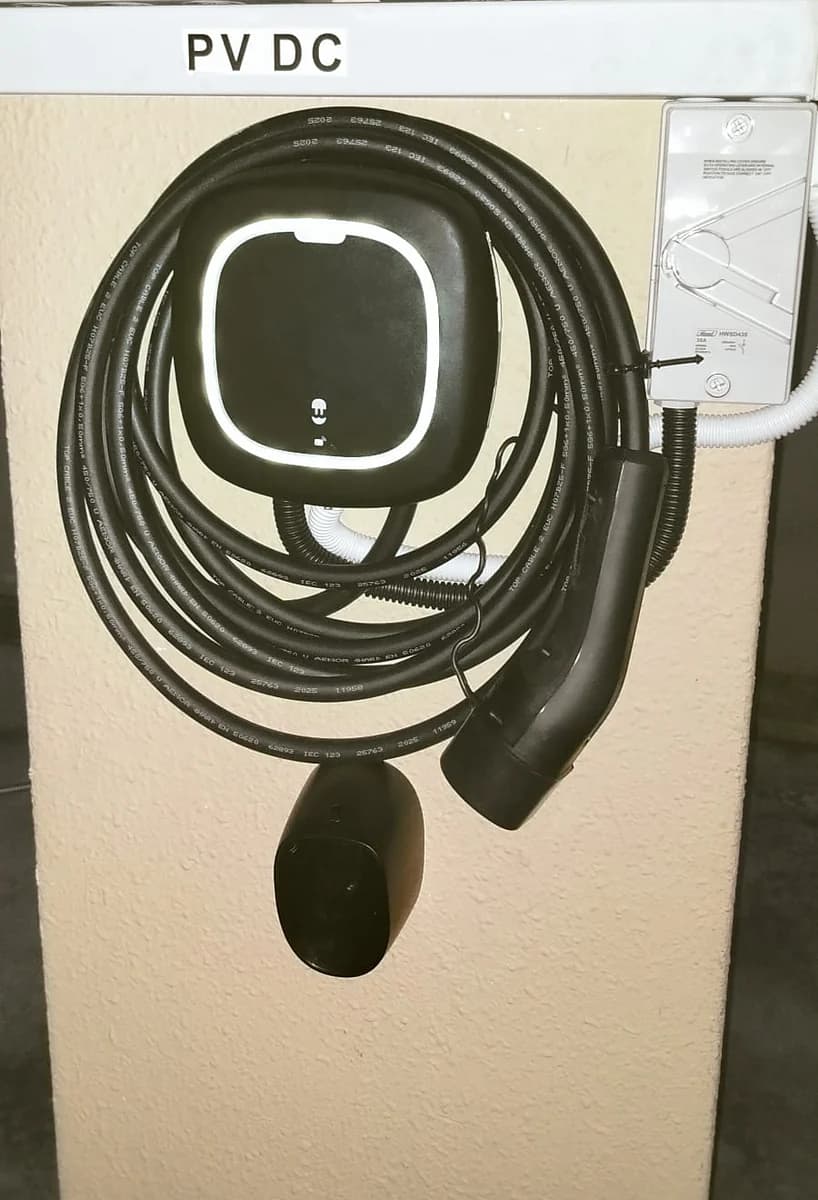
In the home systems we design, a "solar EV charger" is not a special kind of charger. It is a normal type-approved AC wall charger, installed in a home that also has solar panels. The panels feed your home's electrical system, and the charger draws from that system like any other appliance. When the panels are producing, some or all of that power can go into your car. When they are not, the charger draws from a home battery if you have one, and from the grid if you do not.
A complete system has five parts, and it helps to know what each one does:
- Solar panels turn daylight into DC electricity.
- An inverter converts that DC into the AC your home uses, and manages the connection to the grid.
- A home battery (BESS), if you add one, stores surplus solar to use later. See our home battery page.
- The EV charger draws AC power from your home's supply, whatever produced it.
- The grid supplies whatever the panels and battery cannot, and takes any surplus you export.
The charger itself follows the same rules as any other charger in Singapore, whatever powers it. It must be an LTA type-approved model, installed by a Licensed Electrical Worker (LEW), certified, and registered with LTA before it is used. Our guide to LTA approval and registration covers each step.
The timing problem: solar by day, charging by night
Solar panels generate while the sun is up, most strongly around the middle of the day, and nothing at night. Output also drops under cloud and in shade. A car charges whenever it is parked at home and plugged in. Whether those two windows overlap decides how much of your driving runs on your own roof.
If your car is at home during the day, it can take solar directly. If it is out at work and plugged in when you get home, it is charging when your panels are producing nothing, and without a battery that charge comes from the grid. The solar you generated earlier is not wasted: it ran the house during the day, and any surplus was exported. It just did not go into the car.
| When the car charges | Solar, no battery | Solar with a home battery |
|---|---|---|
| Middle of a sunny day | From the panels, as far as their output allows. Any shortfall comes from the grid. | From the panels. Surplus can also top up the battery. |
| A cloudy day | Partly from the panels, the rest from the grid. | From the panels and the battery, the rest from the grid. |
| Evening and overnight | From the grid. | From the battery, as far as its stored energy and power output allow, then from the grid. |
Do you need a home battery to charge your EV with solar?
Not to charge with solar at all. But if your car charges in the evening, a battery is what lets it use your solar. A home battery, or battery energy storage system (BESS), stores the surplus your panels produce during the day and releases it later. It is the piece that moves daytime solar into the evening, when your car is home.
Solar without a battery
- Your home uses the solar as it is generated, and the surplus is exported.
- The car charges on solar only when it is plugged in during daylight.
- Evening and overnight charging comes from the grid.
- Fewer parts, and a battery can be added later.
Suits a car that is often at home in the day.
Solar with a home battery
- Surplus daytime solar is stored instead of exported.
- The car can charge on stored solar after dark, up to what the battery holds and can deliver.
- Set up for backup, the battery can keep essential circuits running in a power cut.
- The warranty term is set by the battery's maker, so compare it when you choose one.
Suits a car that charges in the evening.
Two honest limits. First, a battery delivers power at a limited rate as well as holding a limited amount of energy, so a car charging at full speed can draw more than the battery can supply at once; the difference comes from the grid. Second, storing energy and releasing it again always loses a little along the way. Neither is a reason not to fit a battery, but both are reasons to size it properly rather than buy the biggest one on offer.
Smart charging: scheduling and following the sun
The charger is where you control when and how fast the car charges, and with solar that control is worth having. These are the features that matter:
- Scheduling. Set the charger to start and stop at set times, so charging runs when it suits your system rather than the moment you plug in.
- Solar-aware charging. Some chargers can read a meter at your main distribution board and adjust their charging current to follow the surplus your panels are producing, so the car takes solar that would otherwise be exported. Not every charger or inverter supports this, so it is settled at the design stage, not after installation.
- Adjustable current. Capping the charging current lets the car charge more slowly over a longer window, which can keep more of the charge on solar or on the battery.
There is a floor to all this. An AC charger cannot charge below a minimum current, and on three-phase that minimum is spread across three phases, so the lowest charging power is higher than on single-phase. On a cloudy day, surplus solar can fall below that floor, and a solar-only mode can pause until it recovers. That matters if you want the car to charge on surplus solar alone; we check the charger's own minimum setting when we size the system.
The car sets the ceiling. LTA's guide for drivers puts it plainly: the rate of AC charging is limited by the car's onboard charger. A larger charger only helps if your car accepts the extra power. Our guide to choosing a home EV charger covers the smart features in more detail, and our AC chargers page lists what we install.
Approvals for solar at a landed home
The rules for the solar side come from SP Group's guide for residential consumers, dated December 2022. In short:
- Engage a Licensed Electrical Worker. All electrical work for a solar PV system must be carried out by an LEW, who is responsible for the electrical works associated with it.
- The LEW applies to SP. If the system will be connected to and run in parallel with the grid, your LEW completes the online application through SP's portal.
- No generation licence for a home system. Systems below 1 MWac are exempt from a generation licence, a threshold far above any home rooftop.
- Getting paid for what you export. An ordinary household that is not on the open electricity market (a non-contestable consumer) is paid for exported solar as a credit on its monthly electricity bill. A household on the open electricity market (a contestable consumer) can sell its surplus through SP Services under the Enhanced Central Intermediary Scheme (ECIS).
SP's guide sets that bill credit at the prevailing low-tension electricity tariff minus the grid charge. So for a non-contestable household, each unit exported is credited at less than the tariff paid for a unit bought, which is the basic case for using your solar yourself, in the house or in the car, before exporting it.
How a solar and EV system is sized
Sizing is done at a site visit, not from a table, because the right answer depends on your house and your driving. These are the things we look at:
- Your roof: the usable area, which way it faces, and what shades it through the day.
- Your usage: what the house uses while the sun is up, and what it uses after dark.
- Your driving: how far you drive, and when the car is usually at home and plugged in.
- Your supply: single-phase or three-phase, and the spare capacity at your distribution board. These decide which charger fits.
- Backup: whether you want the battery to keep essential circuits running in a power cut, and which ones.
Single-phase
230V on one phase
32A × 230V ≈ 7.4kW at most
Three-phase
400V across three phases
16A per phase ≈ 11kW · 32A per phase ≈ 22kW
From those we size the panels, the battery if you need one, and the charger as one system. Our solar, EV and battery page has an illustrative sizing table if you want a feel for the ranges before we visit, and our 7kW vs 22kW guide explains the charger choice. You do not have to install everything at once: you can start with the charger and add solar and a battery later, and planning the whole system up front keeps each stage compatible with the next.
One thing that does not change the sums: there is no government grant for an EV charger at a landed home. The case for solar, a battery and a charger rests on your own usage, which is exactly what the site visit models.
How we design and install it
One team designs and installs the whole system, so the panels, battery and charger are planned to work together rather than bolted on one at a time.
- 1
Site visit and design
We assess your roof, supply, usage and driving, and size the panels, battery and charger together.
- 2
Solar application
A Licensed Electrical Worker takes responsibility for the electrical works and, for a grid-connected system, submits the application through SP's portal.
- 3
Panels, inverter and battery
Installed and connected as one system, with the battery set up for the backup circuits you chose.
- 4
The charger
A type-approved charger, installed by an LEW, certified, and registered with LTA before it is used. We can submit the registration for you.
- 5
Integrate and hand over
The charger is tied into the system, and you get one working setup with one team to call.
Book a solar and EV site visit and we will design it around your home, roof and driving. If you only want a charger for now, see our landed home installation page.
Sources
The official pages this guide was checked against.
- Solar Power: Residential Consumers (user guide) (SP Group, December 2022)
- How to Apply for Electricity Connection (SP Group, January 2026)
- Electric Vehicle Guide for Drivers (Land Transport Authority)
- Regulating the safety of EV chargers (Land Transport Authority)
- Registration of EV chargers (Land Transport Authority)
- EV charger grants (Land Transport Authority)
Written by Charge N Go's installation team. We supply and install EV chargers for homes and businesses across Singapore, and we update this guide when the rules or the sources above change.